YIN
A modern standard for monophonic pitch tracking. YIN is optimized here for lower octave-error rates — fewer wrong octave jumps when the partials are messy.
YIN for lower octave-error rates
Free and Pro versions on the web. Built natively for iPhone and iPad. Try Pro features with a free 10-day trial.
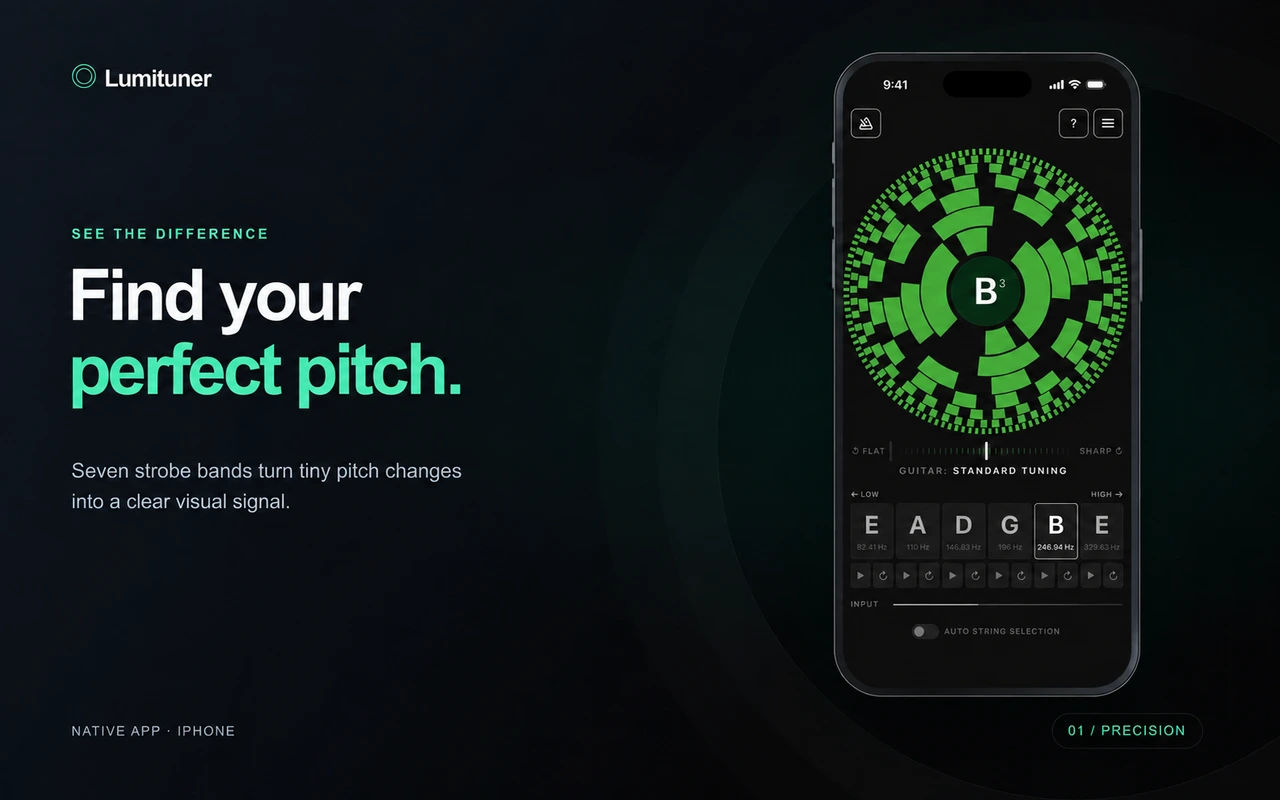
The rings reveal tiny pitch changes in real time. Tune until the pattern holds still, then play with confidence.
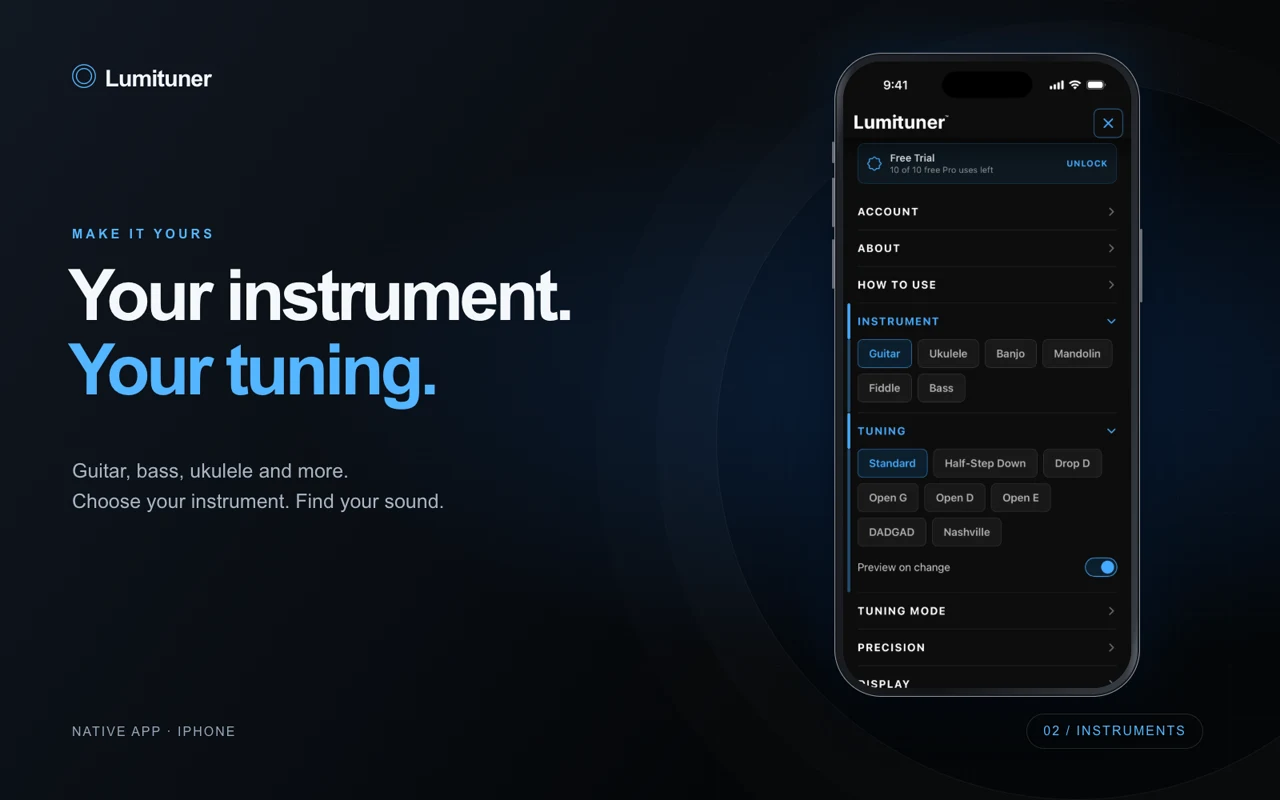
Guitar, bass, ukulele, banjo, mandolin, fiddle — with 20+ built-in tunings from Standard to Nashville to Open G. Create custom tunings for any instrument.
Standard
The reference set for modern guitar work.
Tap any string for a single pitch, or choose a tuning to hear it as a chord.
In Precision, open Pitch Detector and choose from five tuned algorithms —YIN,Autocorr,MPM,AMDF, andCepstrum — optimized for different instruments and playing styles. Pair your choice with sensitivity and smoothing in the same panel.
A modern standard for monophonic pitch tracking. YIN is optimized here for lower octave-error rates — fewer wrong octave jumps when the partials are messy.
YIN for lower octave-error rates
The classic time-domain approach. In the app we tune it for clean, steady signals — when your note is clear and noise is low, Autocorrelation gives a dependable fundamental.
Autocorrelation for clean signals
Tuned for smooth tracking when you bend or use vibrato — the readout follows musical motion instead of jumping around.
MPM for smooth tracking through bends and vibrato
Average Magnitude Difference Function — a lighter-weight detector path for when you want the tuner to use less CPU (older devices, long sessions, or background load).
AMDF for low-CPU situations
Helpful when the instrument puts a lot of energy in the overtones. Cepstrum-style analysis can track the fundamental more confidently if upper harmonics dominate the spectrum.
Cepstrum for instruments with strong upper harmonics
All five feed the same strobe: pick the detector that matches your signal — clean single notes, bends, harmonic-heavy timbres, or lighter CPU — then use A4 reference, in-tune zone, and strobe speed to match how you work.
A little strobe. A lot of personality.
All audio processing happens locally in your browser. No sound data is ever sent to a server. Your microphone input stays on your device — always.
Every detail engineered for professional-grade accuracy.
Seven-band strobe with clear cent-offset feedback
Native iPhone app with offline tuning support
Unlock all five detectors to fit your instrument and signal
Go beyond free Equal temperament with Just, Pythagorean, Meantone, and well temperaments
Presets and custom tunings for more demanding setups
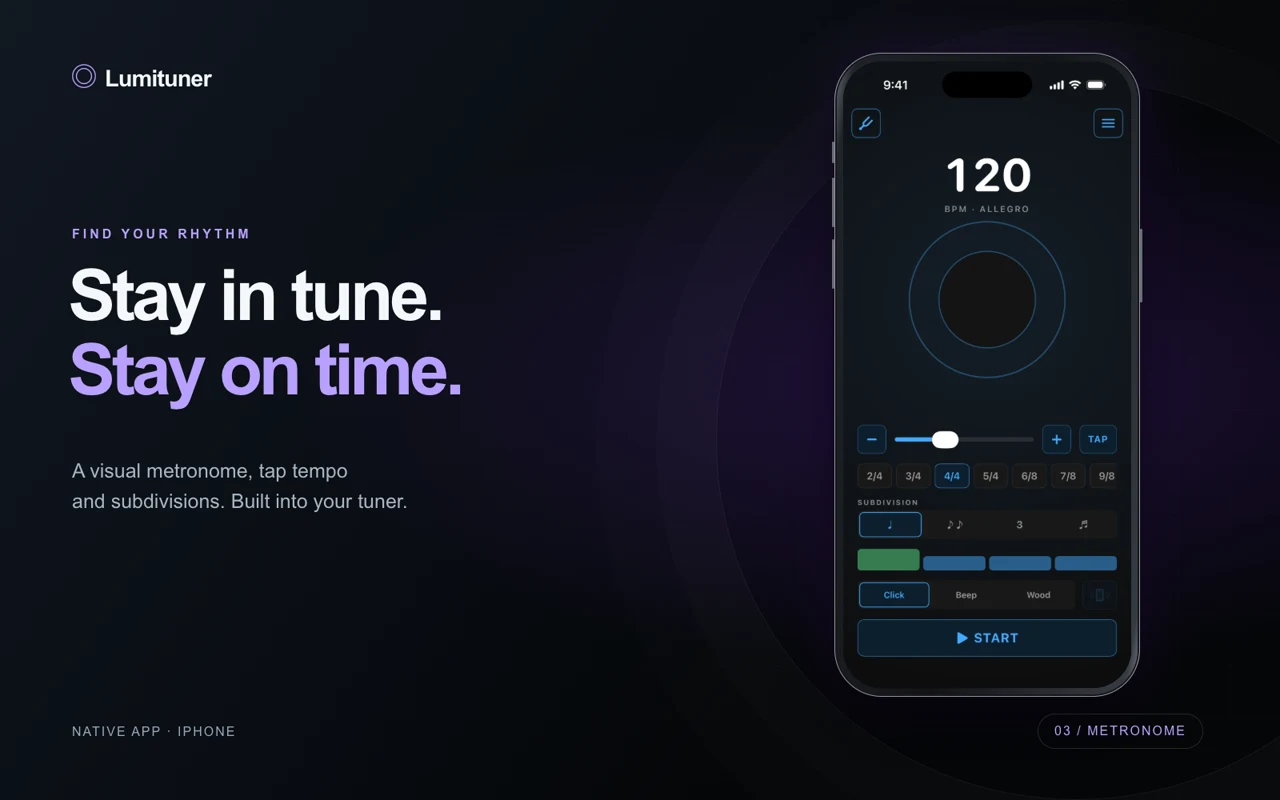
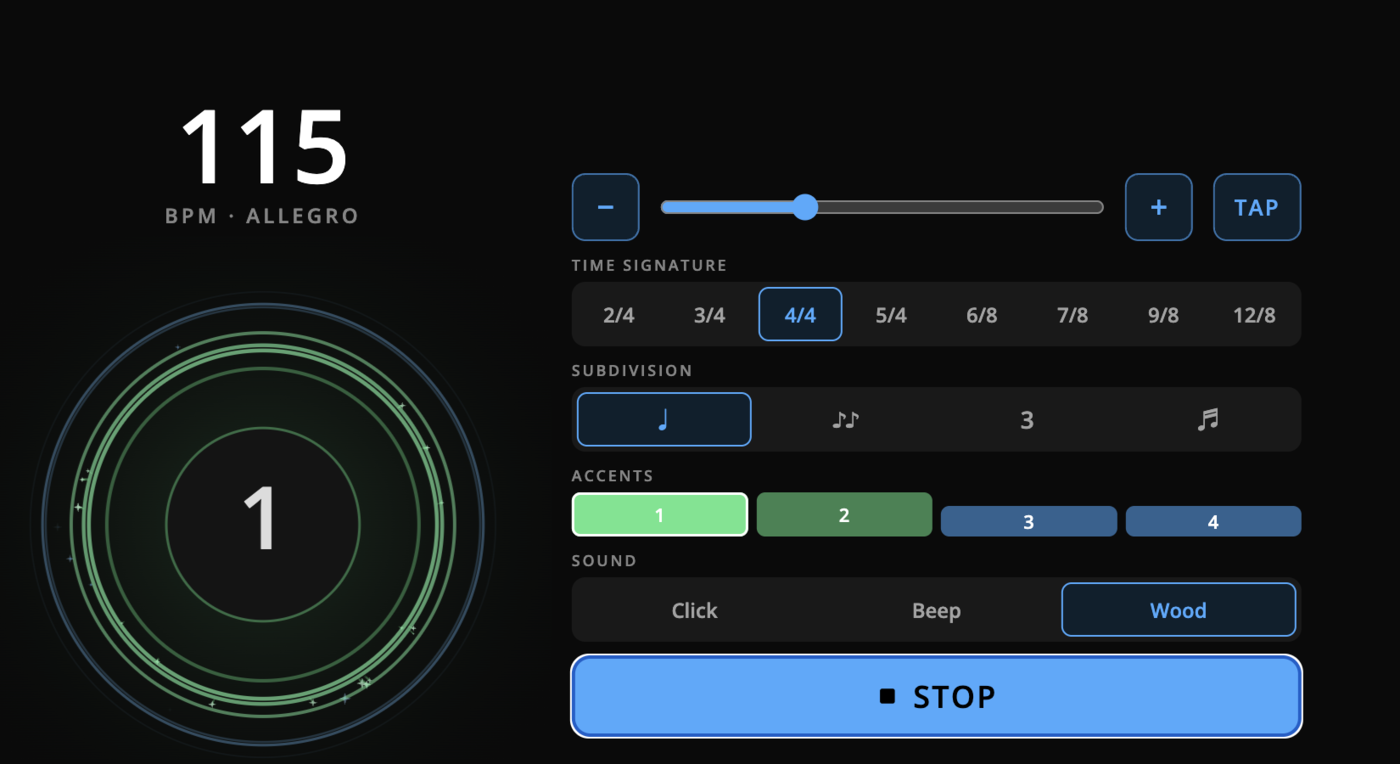
Sample-accurate timing with tap tempo, subdivisions, and accents
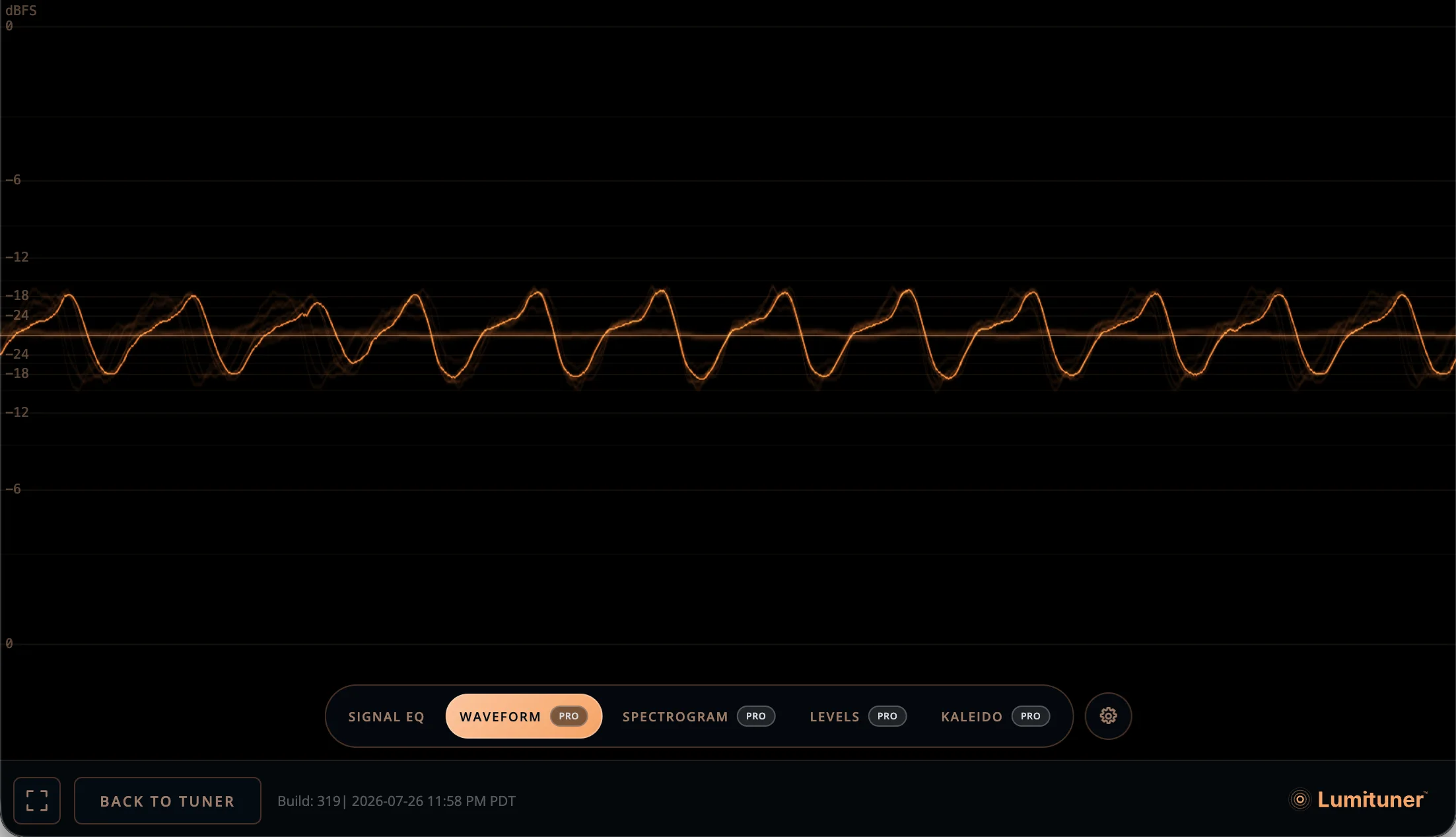
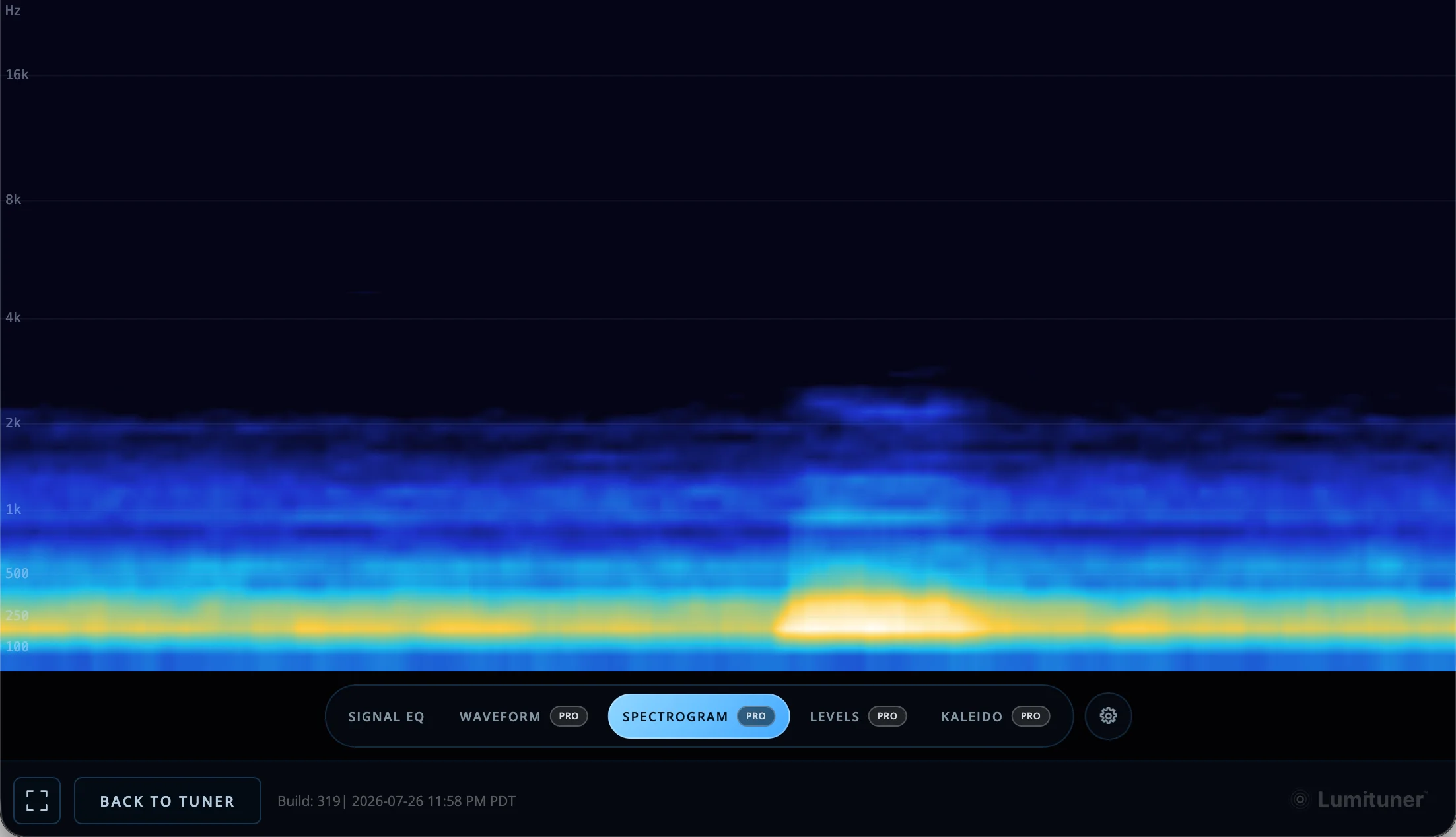
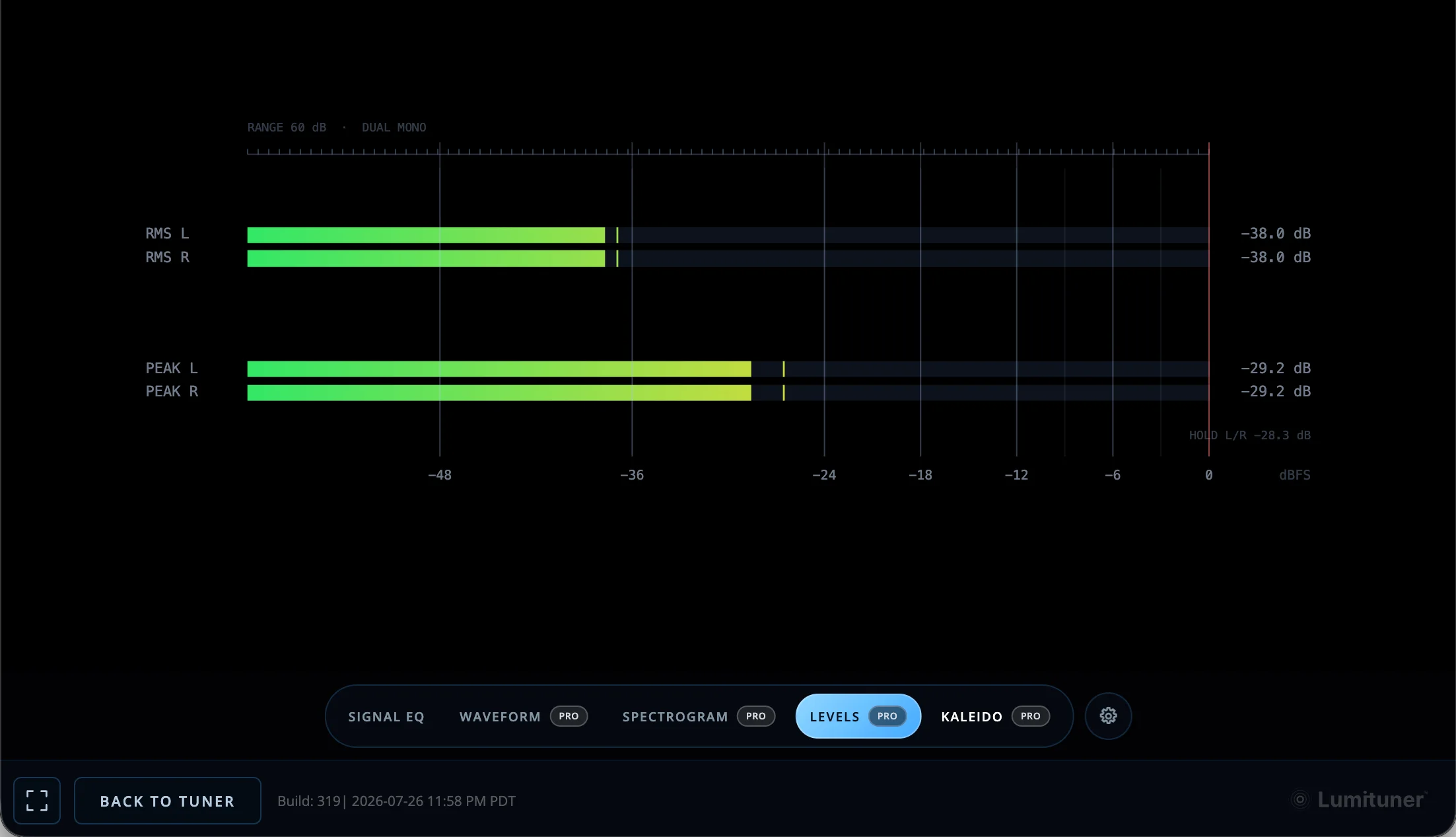
Explore four Pro visualizers, from Waveform to Kaleido
Practice with a metronome that is as visual as it is precise. Set the tempo, meter, subdivision, accents, and sound, then follow the strobe-style beat without losing your place.
Switch from harmonic detail to waveform, spectrum, studio-style levels, or a visual performance mode. Five views reveal a different side of the sound.
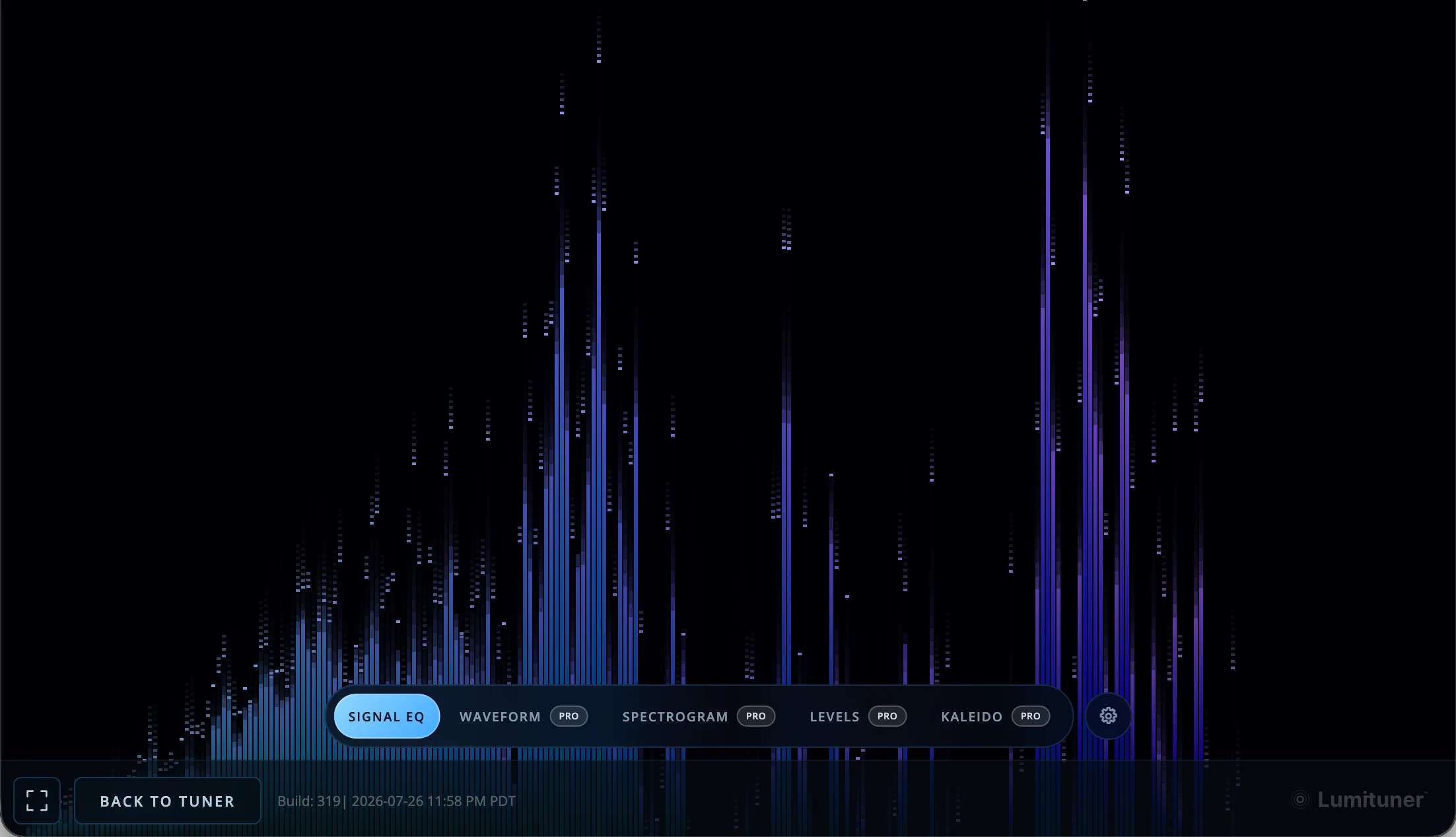
See the harmonic balance of your signal as a field of responsive frequency bars.
A native strobe tuner made for iPhone. See tiny pitch changes, find your tuning, and keep time with a built-in visual metronome.
Release pending. The App Store listing will appear when the iPhone release is available.
See perfect pitch
One purchase
Pro is $12.99 USD once. Unlock the available Pro features on iPhone and web with the same Lumituner account. Sign up to try local Pro tools on ten days of your choice — skipped days don’t count.
Free
All supported instruments, standard tunings, and precise YIN pitch detection. No account needed.
No account required. Your audio stays on your device.
Start tuning — FreePro
Shared access with your account
Bought Pro from Apple? In the iPhone app, open Account, sign in, and link your purchase. Then use that same account here. Apple purchases also work in the app without an account.
Lumituner now carries your selected color through the tuner interface while removing decorative particles and expanding rings to keep the strobe in focus.
A repeatable checklist for checking guitar intonation with open-string and 12th-fret comparisons before moving the saddle.
A quick Drop D tuning guide: which string changes, how to check the octave, and how to verify the result with a strobe tuner.
What determines online tuner accuracy, why microphone quality matters, and how a strobe display makes tiny pitch errors visible.
Learn what left and right rotation mean, why a strobe tuner uses multiple rings, and why a tiny outer-ring shimmer can still mean you are exceptionally well tuned.
Explore Lumituner's five live audio visualizers: Signal EQ, Waveform, Spectrogram, Levels, and Kaleido. Each one reveals a different part of your sound.
Lumituner has a new tuning meter under the strobe disc that shows flat, in tune, or sharp at a glance. Free, ported straight from the iOS app.
A sample-accurate metronome built into the Lumituner web tuner: tap tempo, time signatures, accent patterns, subdivisions, and three click sounds. Included with Lumituner Pro.
A practical guide to common alternate guitar tunings, what they are used for, and how to tune them accurately.
Online guitar tuners can be accurate when they use the right pitch detection, microphone settings, and visual feedback. Here's what matters.
Learn how to check guitar intonation, read 12th-fret pitch errors, and make practical saddle adjustments with a precise strobe tuner.
Strobe tuners detect pitch deviations that needle and clip-on tuners miss entirely. Here's how they work and why professionals rely on them.
Equal temperament is a compromise. Understanding alternative temperaments unlocks better-sounding chords and more musical tuning for specific contexts.
A practical guide to tuning your guitar accurately, understanding what tuning means, and getting the most out of a digital tuner.
Open Lumituner in your browser. The native app for iPhone is coming soon.
Lumituner is built by David Ehlers, a luthier and product designer who got tired of imprecise tuners. Every feature comes from hands-on experience: building guitars, setting up instruments, and demanding accuracy that generic tuners can't deliver.
Share what is working, what feels off, or what would make the tuner more useful at your next session.
Your feedback goes directly to david@notthatthis.com